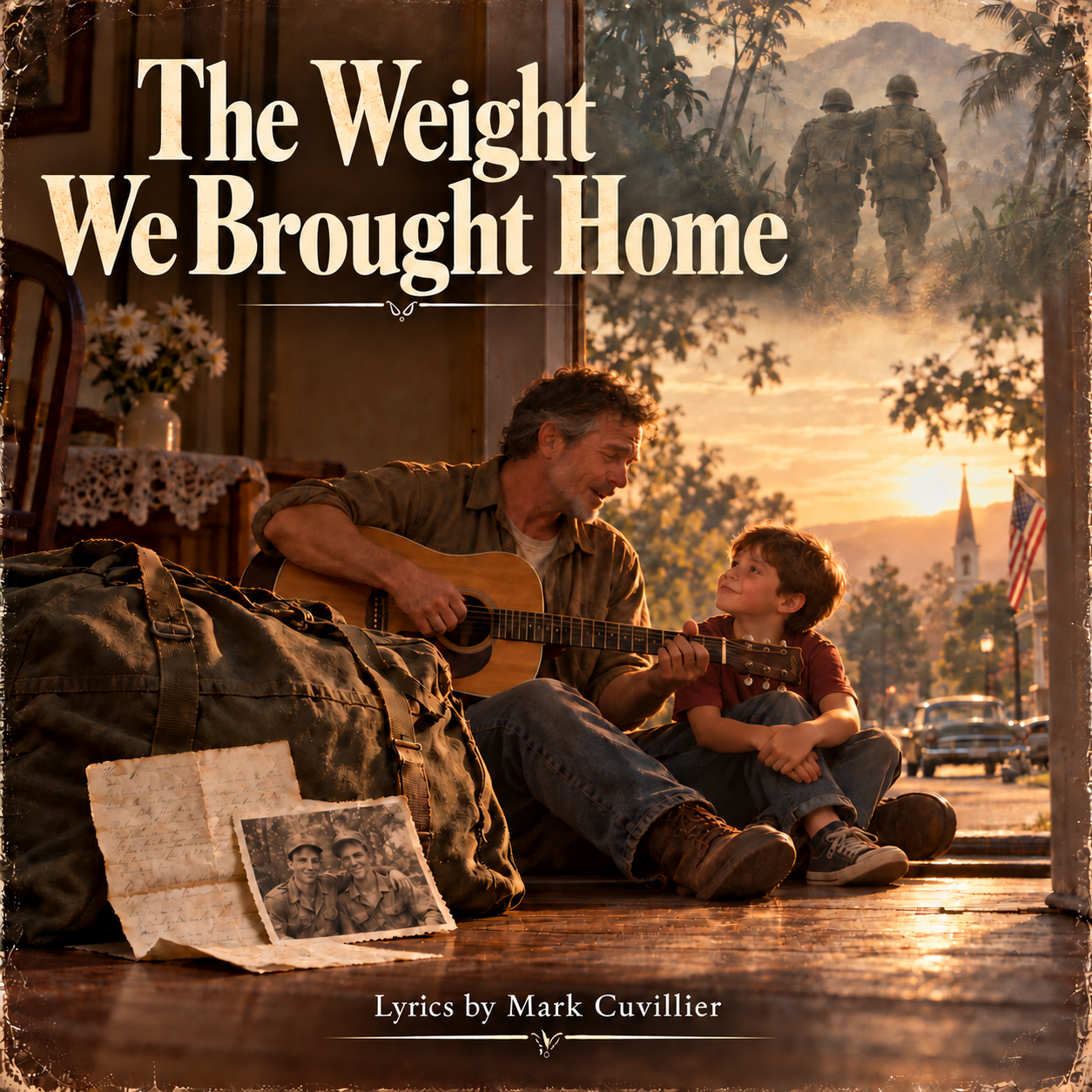
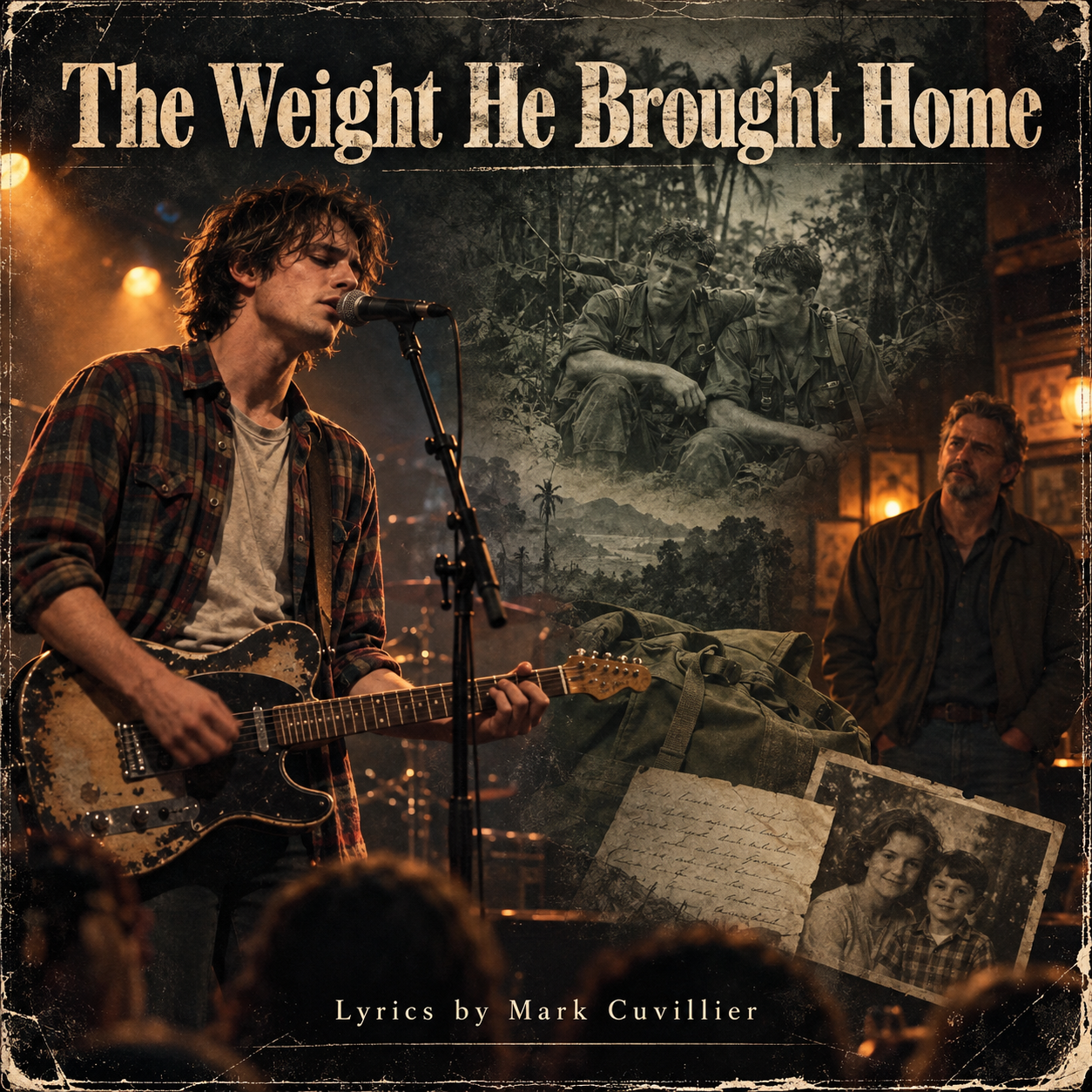
Weight We Brought Home
Original Story
by
Mark Cuvillier
When Robert came home from Vietnam, the Army took back his rifle.
At the discharge station, he laid his duffel bag on the floor, signed the papers they put in front of him, and handed over the things that belonged to the Army.
Then he picked up his bag and walked outside.
He was going home.
At least that was what everyone called it.
Nobody asked about the things the Army couldn't take back.
A few years later, Robert had the kind of life he had once imagined from half a world away.
He had a wife, Rebecca, a little house, and a young son named Michael who followed him everywhere.
On Saturday mornings Robert mowed the lawn while Michael played in the yard. Sometimes Robert would stop the mower and scoop the boy into his arms. Michael would laugh, and for a few seconds Robert wasn't a veteran or a man carrying memories he didn't know how to explain.
He was just Dad.
There was music in the house, too.
Robert wrote songs and played guitar. Michael grew up listening from hallways, bedrooms, and eventually the garage doorway.
Most of his father's songs were meant to be heard.
One wasn't.
Robert called it "The Weight We Brought Home."
It was about Vietnam.
And Patrick.
Patrick had been Robert's closest friend in the war.
Before Vietnam, Robert's mother, Ruth, had handed her son a folded letter.
"Keep it with you," she told him.
It was a little piece of home he could carry into a place that seemed impossibly far away.
In Vietnam, Robert met Patrick.
Patrick talked about home constantly—the people he missed, the things he would do when the war was over, the ordinary life waiting for him on the other side of the world.
Robert listened.
They were young enough to believe they would both get there.
Then, during a patrol, Patrick was killed.
Robert survived.
For years afterward, that difference seemed impossible for him to understand.
Patrick would always be twenty.
Robert kept getting older.
Back home, Robert tried to become the husband and father he believed he was supposed to be.
Sometimes he succeeded.
Sometimes the war followed him into the house.
Rebecca saw sides of him Michael was too young to understand. Anger could arrive without warning. Robert could withdraw just as quickly. The loving father mowing the lawn and laughing with his son could become distant, irritable, or unreachable.
Michael didn't know about Patrick.
He didn't know what his father had seen.
He only knew what it felt like to live with what Vietnam had left behind.
And slowly, something began to break between father and son.
Robert rarely spoke about the war.
Instead, he wrote.
Late at night, alone in the garage with his guitar, he sometimes sang the song he couldn't sing anywhere else.
Michael heard it.
Robert never knew.
Year after year, Michael listened to pieces of his father's story through a wall.
They took his rifle when he landed...
The song told Michael something his father never could.
There had been a friend.
There had been a death.
And his father had carried it home.
Michael grew up.
Eventually, he joined the Army himself.
For Robert, watching his son put on a uniform stirred feelings he couldn't explain. Pride was mixed with fear. Memories he had spent years burying began pushing toward the surface.
Michael had his own life now.
He had Kelly, the girl he had loved since high school, and a close Army friend named Daryl.
Then Michael received his own lesson in how quickly a life could divide into before and after.
Daryl died in a training accident.
There had been no jungle and no enemy patrol.
But grief did not care.
Michael finally understood something about his father.
Not everything.
But enough.
He understood what it meant to keep living when somebody beside you didn't.
And like his father, Michael began putting things into songs that were too difficult to say aloud.
The distance between Robert and Michael eventually erupted.
Years of misunderstanding became words that could not be taken back.
Michael accused his father of being a coward.
A liar.
Not because Robert had been afraid in Vietnam.
Because he had never told his son about the man whose death had shaped their family.
Patrick.
Robert froze.
Michael knew the name.
How?
Robert had never told him.
What Robert didn't know was that Michael had been listening all those years.
The song Robert thought he sang alone had never really been private.
His son had grown up hearing it.
And through the music, Michael had come to know the young soldier his father could never bring himself to talk about.
Time passed.
It did not erase what had happened between them.
But it softened some of the sharpest edges.
Then Michael and Kelly had a son.
At the hospital, Rebecca stood beside them, looking down at her grandson.
"What did you name him?" she asked.
Michael looked at his mother.
"Patrick."
Rebecca smiled.
It was a beautiful name.
Then the camera of memory, if memory had a camera, would have turned toward Robert.
He didn't smile.
Not at first.
He simply stared at his son.
Patrick.
The name of a twenty-year-old boy who had died in Vietnam decades before.
A name Robert had carried silently through marriage, fatherhood, anger, music and old age.
His son knew.
Robert didn't ask how.
Maybe some things didn't need to be explained.
Later, Michael stood on a stage with his father's guitar.
He was approximately the age Patrick would always be in Robert's memory.
Robert stood somewhere toward the back of the room.
Michael began to sing.
It wasn't his father's song.
Not exactly.
It was the son's answer to it.
"The Weight He Brought Home."
Michael sang about the rifle the Army took away.
The duffel bag his father put down.
The things that never left his shoulders when he walked back through that door.
And then he sang about Patrick.
Robert listened.
For decades, he had carried the name alone.
Now his son carried it with him.
And his grandson carried it into another generation.
Years earlier, a little boy had stood outside a garage and secretly listened to his father sing about a war he couldn't understand.
Now Robert returned to that garage.
The old guitar was there.
So were the memories.
For perhaps the first time, they didn't seem quite as heavy.
Robert had once believed surviving meant carrying everything himself.
He had been wrong.
Some burdens aren't passed from father to son because a father chooses to give them away.
Children inherit pieces of our stories simply by living beside us.
They hear the words we say.
They feel the things we don't.
And sometimes they spend half a lifetime trying to understand the difference.
Robert had brought something home from Vietnam.
For years, it had hurt the people he loved.
But Michael had taken that inheritance and done something different with it.
He had turned it into understanding.
Into music.
Into a name.
And finally, into grace.
The story ends where the secret began—with a song.
Only this time Robert isn't alone in the garage.
He is standing on a stage before a large audience.
He lifts the guitar.
And for the first time, "The Weight We Brought Home" isn't something he has to carry by himself.